

November 10, 2026
From 3D models and connected machinery to practical applications for AI, the steel workshop is becoming smarter - while skilled people remain at the centre of every successful project.
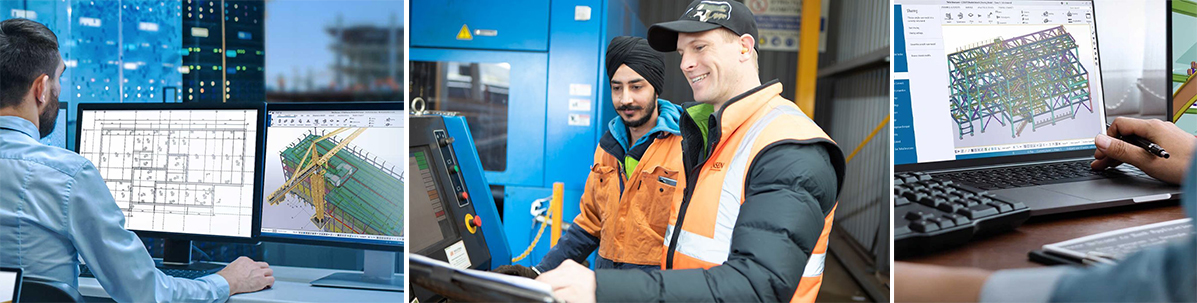
The workshop of the future will still need steel, welders, fabricators, detailers and engineers. Alongside them will be increasingly sophisticated CNC machinery, digital models, connected systems, automation and artificial intelligence.
The goal isn't to replace people with machines, but to give skilled people better tools to work safely, accurately and efficiently. Ultimately, any new technology must improve the process and the finished structure.
Steel fabrication has moved beyond paper drawings and manual measurements. Today, a detailed 3D model can provide a common source of information for detailing, shop drawings, material requirements, CNC processing, quality assurance and site installation.
At Jensen Steel, Tekla software supports detailed modelling and the flow of fabrication information into workshop processes. Following one beam tells the story: engineer, digital model, shop drawing, machine data, fabrication, quality checks, transport and installation. Reliable information throughout this chain helps reduce rework, delays and misunderstandings.
Automation is most valuable when it handles repetitive, physically demanding or highly consistent tasks, allowing skilled people to concentrate on work that requires judgement. CNC drilling, cutting and coping can improve repeatability and productivity, while reducing manual handling and repeated measurement.
Jensen Steel’s Daito DCM and beamline technology are practical examples: machines perform defined processing tasks accurately and consistently, while experienced people plan the work, solve unusual problems, inspect quality, make decisions and keep projects moving.
Automation also creates opportunities to rethink how work flows through the workshop. When repetitive processes become more consistent, teams can focus on improving coordination between production stages, identifying issues earlier and making better use of available resources. The future of fabrication is not people versus machines. It's people working effectively with machines.
Artificial intelligence is creating practical opportunities in manufacturing, particularly where large amounts of information need to be checked, compared or interpreted.
HERA's Manufacturing 4.0 research is exploring AI, robotics and connected manufacturing, including AI-based monitoring to assess product quality, optimise inspection requirements and help manage compliance risks through data analysis.
Recent developments highlight what this could mean in practice.
Making inspection and reporting easier
Paper forms, spreadsheets and manual data entry can make inspection results difficult to retrieve and reports time-consuming to prepare. Digital inspection applications can capture results, including visual information, and generate reports more efficiently, helping teams identify recurring issues and improve quality processes.
Helping check material compliance
On 28 September 2026, HERA published a case study on an AI chatbot designed to help check material certificates for compliance.
The system searches material test certificates, retrieves relevant welding-standard requirements and provides answers traceable to their sources. HERA plans to develop this capability further through its AI-based Fabrication Compliance Management System (FCMS).
Such tools could reduce time spent searching technical documents and help flag potential discrepancies for review. Human oversight remains essential to interpret requirements, assess exceptions and ensure materials and finished work meet the relevant standards.
Finding information and making better decisions
AI can help people search complex technical documents, drawings, specifications and quality reports using everyday language.
Production planning offers further opportunities. Reliable data combined with simulation and mathematical optimisation tools can help identify bottlenecks, test scheduling scenarios and improve the allocation of people, machines and materials.
These technologies can help fabricators find information faster, identify issues earlier and improve planning, quality and compliance.
Staff Insight – What AI Could Mean for Steel Fabrication
Following HERA’s AI for Structural Steel Fabricators presentation, Luke Te Whau, Quality Assurance Manager, gained a closer look at how emerging technologies could help address some of the everyday challenges faced by steel fabricators. One takeaway that stood out for Luke was:
“AI will allow us to minimise mundane tasks like data entry, basic coding, or initial drafting - it rarely automates an entire job. Instead, it alters the day-to-day responsibilities of workers, moving them into the role of editors, managers, and decision-makers who direct the technology”.
For Jensen Steel, this could create opportunities to accelerate productivity by automating repetitive workflows.
As Luke notes, AI is only as good as the data it accesses. He explains:
The next step is not simply adding more technology; it's connecting the information already being created. Digital models can inform production planning and material allocation, machine data can support progress reporting, and quality records can follow fabricated steel through dispatch and installation.
HERA's AI presentation highlighted the challenges of identifying production bottlenecks before they affect delivery. When information is scattered across spreadsheets and disconnected systems, delays can go unnoticed until other jobs are affected.
Better-connected production information can help teams track progress across detailing, cutting, welding, painting and dispatch, identify downstream impacts and respond earlier.
Simulation tools can model workshop processes to reveal constraints and test different scenarios before changes are made on the shop floor.
Mathematical optimisation can help schedule work and allocate people, machines and materials around deadlines and available resources.
These tools depend on accurate, structured and accessible data. Technology cannot reliably solve a problem if its underlying information is incomplete or inconsistent.
Connecting processes within a business is known as vertical integration. Sharing information more effectively with customers, suppliers and project partners is horizontal integration. Together, these connections can help information flow from design through manufacturing to site, supporting better coordination and more informed decisions.
Better-connected information opens the door to stronger traceability. A steel component's digital record could include its source, grade, fabrication details, welding information, inspections, coatings and installation history, helping inform future maintenance or end-of-life reuse.
Reliable digital records also make material certificates and inspection results easier to retrieve for quality checks, audits and maintenance. This brings technology, quality, compliance and sustainability together, giving project teams a clearer view of a component's history from raw material to finished structure.
Even the smartest workshop depends on people who understand steel. Traditional fabrication and welding knowledge now sits alongside digital modelling, CNC operation, data literacy, quality assurance and process improvement.
AI can retrieve information, identify patterns and flag potential issues, but experienced people must interpret results, recognise when something doesn't look right and make informed decisions.
As technology advances, people who understand both fabrication and digital tools will become increasingly valuable. Training and practical experience remain essential to turning investment into genuine improvement.
Steel fabrication will continue to evolve, but its purpose remains the same: turning engineering intent into structures people can rely on.
At Jensen Steel, the opportunity is to combine proven fabrication knowledge with the right technology. Every investment must have a practical purpose: improving accuracy, safety, productivity, quality or communication, or reducing waste.
The starting point is a real opportunity for improvement. By understanding the problem, testing solutions and assessing their benefits, Jensen Steel can ensure technology earns its place in the workshop. This reflects the company's commitment to continuous improvement and exceptional project delivery for its customers.
At the end of the day, there will still be steel. What changes is how technology helps skilled people do their best work. And at Jensen Steel, it's a journey the team is excited to be part of!